


 Ugadi significance…
Ugadi is basically a Hindu festival signifying the time element of the Universe celebrated as a New Year Day coinciding with Chaitra Masam (the first lunar month), Sukla paksha (bright fortnight), Prathama Thithi (first lunar day) as per Lunar Calendar called Chandramana. It is a festival mainly celebrated in the southern part of India and Maharashtra. In Andhra Pradesh and Karnataka it is celebrated as Ugadi while in Maharashtra it is called as Gudi Padwa. In all the three states it is celebrated as per Chandramana. In Tamil Nadu and Kerala it is celebrated as per Sowramana (Solar calendar) on the day Sun enters Mesha Raasi (Aries sign) in the zodiac called as Mesha Sankranthi that generally occurs during the months of March/April every year that is referred to as Solar New Year (Souramana Ugadi). As per Chandramana a month is denoted by the star present on the full moon day. For example the month in which Moon is at or nearer to Chitta star that month is reckoned as Chaithra maasam the first day of which is celebrated as Ugadi festival.
 Uttarayana is first among the Aayanas; Vasantha Ruthu (Spring season) is first among the seasons, Mesha Raasi (Aries) is first among the zodiac signs, Chaitra Masam is first among the Lunar months, Sukla Paksha is first among the fortnights, Prathama (Paadyami) is first thithi among the lunar days. The day that coincide with the confluence of all the above mentioned is celebrated as Ugadi. It is an occasion that also signifies the end of an era and beginning of a new era. The day marks the onset of spring season called Vasantha Ruthu first among the six seasons in a year Vasantha, Greeshma, Varsha, Sharad, Hemantha, and Sisira.
The word Ugadi is derived from the word Yugaadi (Yuga + Aadi). Yuga means the period or era and Aadi means beginning. Ugasya Aadi = Ugadi (beginning of Yuga). Uga also means the star movement; the day creation had started; the day Yuga had commenced. Ugadi marks the beginning of an Era/Yuga called as Ugadi which specifically mentions the period in which currently we are living. It also marks the beginning of new Sakha calendar and that day is celebrated as the Hindu New Year (Nootana Samvatsara) Ugadi.
 Ugadi is assumed as the day Lord Brahma had commenced the creation; it is also the day Kalpa had commenced known as Kalpaadi. To commemorate the commencement of Creation, this day is celebrated as Ugadi. According to Valmiki Ramayana it is said that Lord Sri Rama had killed the demon Ravanasura on the day previous to Ugadi falling on the New Moon Day (Amavasya) of the last lunar month Phalguna masam. To commemorate the victory of Lord Sri Rama next day is celebrated as Yugaadi festival marking the beginning of a new era.
As per Vedamana it is believed that the creation had started approx 197 crore years back. As per Yuga pramana life span of Kali Yuga is 432,000 years. Chandramana Calendar has sixty year cycle and each year Ugadi is denoted by a specific name starting from Prabhava and ending with Akshaya. After completion of sixty years the calendar starts anew with its first name again cyclically getting repeated.
Thailabhyanganam…
Sun worship on Ugadi…
Nimba Kusuma Bhakshana
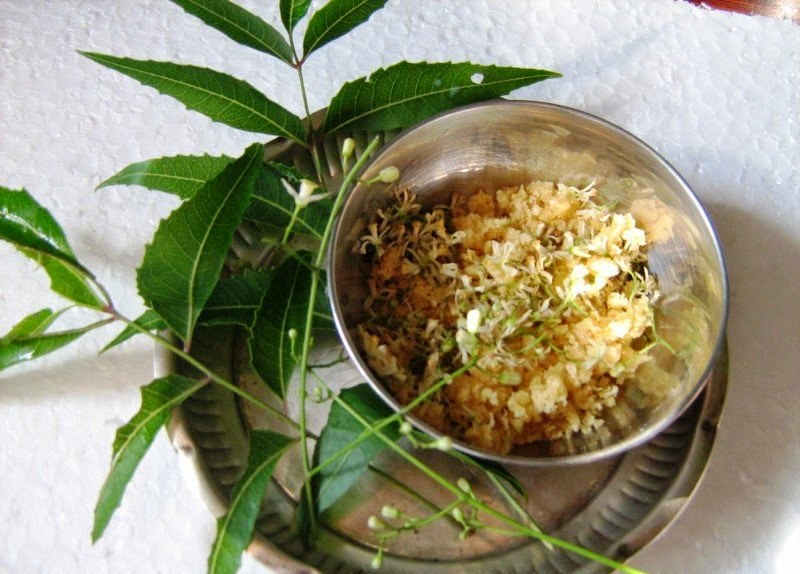 Nimba means Neem and Kusuma means flower. Tradition is that, on the day of Ugadi people eat in the morning after taking bath a pickle (sauce) made with a combination of six ingredients that gives six different tastes (Shadruchi). The ingredients are neem flowers, raw mango, jaggery, new tamarind, dry/green chillies, and salt. In some places people use sugar cane instead of jaggery and pepper instead of chillies. It is popularly called as Ugadi Pachhadi in Telugu, Bevu-Bella in Kannada.
There is also a health message involved in eating this. Neem is good for diabetes, skin diseases and acts as a blood purifier. It is called as Sarva roga nivarini. Even today usage of neem leaves is prevalent in rural areas whenever any one is infected with small pox/chicken pox. Jaggery helps in increasing the hemoglobin content of blood that helps in iron deficiency, Tamarind helps in removing excess of kapha, vata, and pitta, raw Mango works in throat related problems and enhances the appetite, Salt gives energy, Chillies removes kapha and vatha, pepper helps in cold and works in throat related problems.
Panchanga Sravanam…
 Panchanga means the Almanac that contains astronomical/astrological details mainly related to Thithi, Vaara, Nakshatra, Yoga, Karana together called as Panchaanga (Pancha + Anga) the five limbs or five elements that helps in the identification of various auspicious or inauspicious moments in electional astrology. Panchanga also indicates the forecasts for eclipses, weather, monsoon, transit of planets, implications to individuals based on their birth stars, zodiac signs, rasi phala and general trend with respect to economy, political scenario etc.
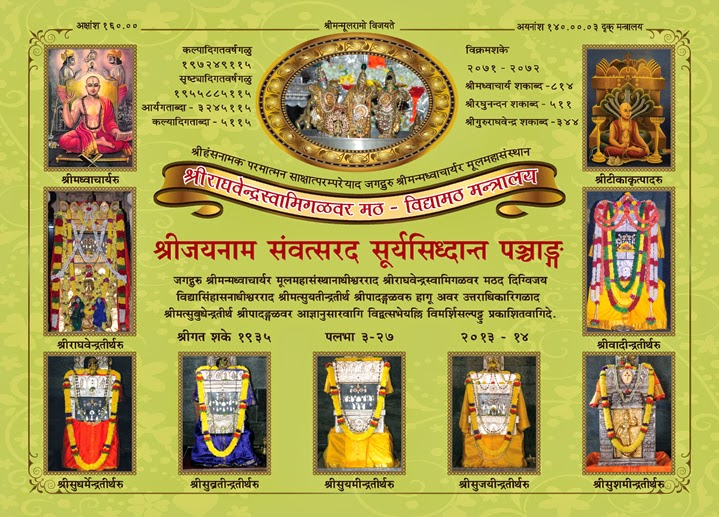 Panchanga (Almanac) involves lot of mathematical and geometrical calculations based on side real system, understanding of astronomical phenomena such as movements of heavenly bodies the Sun, Moon and other planets. Mainly Panchanga is based on Surya Siddhantha or Dhrugganitha. Panchangas are published by various authors/agencies in various regional languages based on different philosophies prevailing in Hindu religion. Traditionally people gather on Ugadi day to listen to the learned, the recitation of Panchanga and general forecast for the forthcoming year. In the present days of Television technology this type of gatherings have come down as people listen Panchanga Sravanam from a live telecast by various regional Television Channels. It is said and believed that Panchanga Sravanam (reading/listening to the Almanac) on Ugadi day gives auspicious results.
Nakshathradharathe papam, yogadroganivaranam
Karanathkarya siddhisthu panchangaphalamutthamam
Kala Vithkarma Kruddhimaan Devathanugraham Labheth
Panchanga Sravana on the day of Ugadi is very auspicious. It is said that it gives the results (phala) equivalent of taking bath in sacred river Ganges, blessings of Navagraha. Sun gives courage and glory, Moon gives status, Mars gives auspiciousness, Mercury gives intelligence, Jupiter gives knowledge, Venus gives comfort and happiness, Saturn removes sorrow and obstacles, Rahu gives popularity, and Kethu gives significance.
PradanathPitharasarve Thrupyanthucha Pithamaha
Anivaarya Mithodeyam Jalammaasa Chathustayam
Udakakumbha daana…
 In Bhagawadgita Vibhooti Yoga, Lord Sri Krishna saysRuthunaam Kusumaakarah; that means, He is Vasantha Ruthu (Spring) most sacred among the seasons. Like we celebrate the nine day festival during Dasara season, similarly a nine day spring festival is celebrated beginning from Ugadi (Chaitra Sukla Paadyami) and ending with Sri Rama Navami. During these nine days Goddess Durga Devi is worshiped. In some places it is celebrated as Sri Rama Navarathri worshiping Lord Sri Rama during these nine days. Ninth lunar day starting from Ugaadi is celebrated as Sri Rama Navami. People also perform parayana of sacred texts like Ramayana, Sundarakanda, Devi Bhagavatham during these nine days.
Gudi Padwa…
In Tamil Nadu Ugadi is celebrated as Puthandu (Varusha Pirappuv) festival and in Kerala it is celebrated as Vishu festival. It is celebrated as a New Years day even in Punjab, Assam, West Bengal, Orissa states. In Punjab it is called as Baisakhi. In Andhra Pradesh and Karnataka it is also marked by literary discussion, poetry recitations, honouring of authors of literary and poetic works, cultural programs, Kavi Sammelana etc. In the evening people gather together and exchange greetings.
In some regions especially in Andhra Pradesh there is a myth that how one live on the day of Ugadi; akin will be the way one lives throughout the year. More than the myth the philosophy is we reap what we sow as the old saying goes. You sow the good then you reap the good. A good thought/action has a good result and an evil thought/action has a bad result. We are the makers of our own fate. As per Karma Philosophy we sow seeds of Karma for our future births through our thoughts and vision and plan for our Karma (Agami Karma) in future births. To attain good results, the foundation we lay for our thought/action should be good from day one perhaps from the Ugadi Day.